Why Python & React: The Pragmatic Full Stack

When designing an application framework for mission-critical business software, language and library choices always spark debate.
Why not Go? Why not TypeScript across the entire stack? Why not HTMX or Svelte? Why not Rust or Java?
At Framework M, we chose Python on the backend and React on the frontend intentionally. Not out of nostalgia or momentum, but because of a deliberate architectural conviction: pair the ideal control plane with the gravitational center of enterprise UI.
1. The Real Job of an Application Backend
Whether you are building an ERP, a multi-tenant SaaS platform, or a specialized fintech engine, what does the application layer actually spend its time doing?
Even in high-volume systems, the business application layer is rarely running raw mathematical loops in user space. Its real job is:
- Ingress & Invariant Enforcement: Decoding payloads, strictly validating schema constraints, and sanitizing inputs.
- Authorization & Multi-Tenancy: Evaluating fine-grained permissions, tenant boundaries, and dynamic policy engines.
- Domain Workflows & State Transitions: Orchestrating lifecycles, ledger commits, reconciliation pipelines, and business rules that evolve constantly.
- Coordination & Dispatch: Marshaling work across distributed consensus ledgers, transaction queues, caches, and partner APIs.
If you are building a specialized fintech ledger, the storage engine itself (e.g. TigerBeetle, RocksDB, or custom Zig/C engines) handles deterministic state-machine replication and sub-millisecond balancing.
The application backend's job is orchestration, domain validation, and policy control. For that layer, you need maximum ergonomics, rapid iteration, and rock-solid schema safety without boilerplate drag. Python delivers that full spectrum: clean scripting for migrations, functional pipelines, and disciplined OOP for complex domain models.
2. Pydantic V2 vs. Reflection Hell
The biggest technical advantage Python holds today over TypeScript and Java in high-throughput data processing is Pydantic V2.
- TypeScript / Node / Bun: TypeScript types are erased at compile time. At runtime boundaries (validating incoming JSON), you are forced into duplicate bookkeeping (Zod, TypeBox) or slow JS-based validation loops.
- Java / Spring Boot: Dynamic schema inspection relies on reflection (
reflect-metadata, Jackson, bytecode enhancement). It comes with heavy JVM warmup costs, enormous memory footprints, and constant friction with ahead-of-time (AOT) native compilation like GraalVM. - Python + Pydantic V2: You declare clean, pythonic type hints. Under the hood, serialization, coercion, and validation run in compiled Rust (
pydantic-core).
Framework M gets the syntax ergonomics of Python with compiled machine speed exactly where CPU cycles matter most: at the validation and serialization boundary.
3. The Layered Engine: Python on Top, Compiled at the Bottom
A common misconception is that picking Python means your network sockets and computational bottlenecks must run on slow interpreters.
Modern architectures do not work that way:
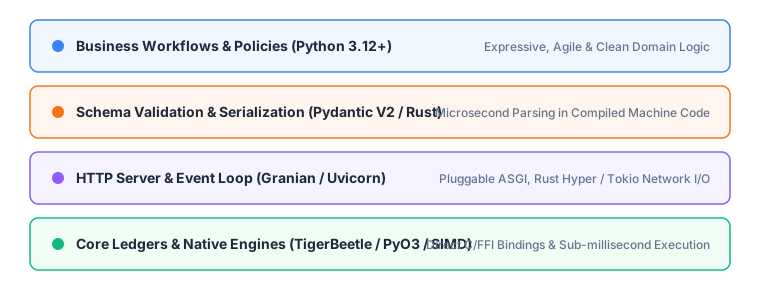
- Pluggable & Unbloated ASGI Serving: Framework M does not bundle or force a monolithic web server on you. By decoupling server extras (
framework-m-standard[server-granian]andframework-m-standard[server-uvicorn]), you only install what your production profile demands. Out of the box,m prodauto-detects your runner: drop in Granian (written in Rust on top of Tokio and Hyper) for extreme network I/O and native WebSocket throughput, or stick with Uvicorn for standard environments—without touching a single line of application code. - High-Throughput Ledgers: When we integrate with systems like TigerBeetle, we talk directly via native C/FFI bindings.
- Compute Bottlenecks: When a domain reaches Python’s limits, we do not rewrite the architecture. We drop into PyO3 or C libraries, keeping the clean Python API intact.
4. The Healthy Obsolescence Paradox & Port Isolation
A common critique of Python is that its rapid evolution—type hinting advances, async improvements, runtime changes—makes code evolve faster than in 15-year static Java codebases.
We view this as a feature, not a bug.
Code that never breaks or evolves easily becomes a terrifying, unmaintained legacy black box. Because Python code is concise (often 3x to 5x fewer lines than Java or Go), refactoring it is cheap. Python forces you to build automated test suites, maintain CI/CD hygiene, and keep dependencies healthy.
Crucially, Framework M’s Port & Adapter architecture isolates this obsolescence. When an underlying driver, upstream library, or protocol changes, only the boundary adapter adapts; your domain models, business policies, and core doctypes remain completely untouched.
5. Why React on the Frontend?
If Python is the brain and control plane, why React for the presentation canvas? Why not Svelte, Vue 3, or HTMX?
The answer comes down to one decisive reality: Ecosystem Gravity in 2025.
The Enterprise Component Moat
Consumer websites and blogs can afford to chase frontend framework trends. But an Enterprise ERP and Business Control Plane has a radically different UI profile:
- 100,000-row virtualized tables with column reordering, multi-sorting, and inline pinning (TanStack Table).
- Accessible keyboard-driven command palettes, modals, and popovers (Radix UI / Shadcn).
- Interactive visual workflow graphs and node transition canvases (React Flow).
- In-browser code editing, JSON diffing, and template authoring (Monaco Editor).
In 2025, 95% of mature, production-grade enterprise UI component libraries are built React-first. Choosing an alternative like Svelte or Vue means your team spends thousands of engineering hours building accessible dropdowns, virtual tables, and canvas connectors from scratch—distracting you from building real business features.
Developer Availability & Third-Party Plugins
Framework M is designed for extensibility. Third-party developers, community contributors, and in-house teams build custom business doctypes, pages, and integrations.
- React is the universal lingua franca of frontend engineering.
- Requiring developers to learn a proprietary UI language or an esoteric framework adds needless friction.
- With React and TypeScript, any frontend developer can be productive on Day 1.
6. The Schema Bridge & The uniforms Lesson
The true power of Framework M is the bridge between the two layers: Python DocTypes directly generate React interfaces.
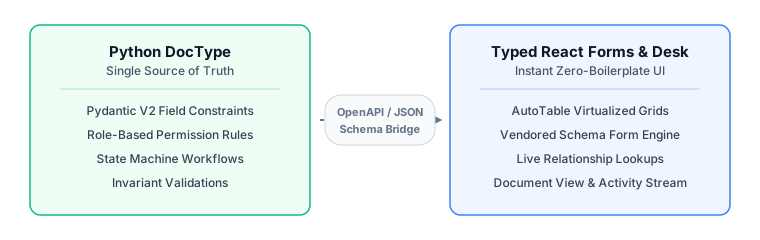
You define a DocType once in Python. The framework inspects its fields, types, and validation rules, generating:
- Pydantic runtime validation on the backend.
- OpenAPI specifications on the wire.
- Fully functional React forms, tables, and detail views in Desk without manually hand-crafting form JSX.
The uniforms Lesson: Owning the Contract
To render dynamic forms from schemas, we leveraged the schema-to-form bridge pattern popularized by libraries like uniforms. But enterprise software requires long-term reliability. When an upstream open-source dependency stalls or drifts, we don't let it jeopardize downstream stability.
We vendor the form engine, take complete ownership of the contract, and customize it for Framework M's DocTypes. Downstream applications get rock-solid, predictable forms that evolve on our schedule, not NPM churn.
7. The Unified Picture
| Layer | Technology | Architectural Role |
|---|---|---|
| Control Plane | Python 3.12+ | Expressive domain logic, state machines, and native AI/LLM integration. |
| Data Boundary | Pydantic V2 / Rust | High-throughput parsing, microsecond serialization, strict schema safety. |
| Server Core | Granian / Uvicorn | Pluggable, high-concurrency ASGI networking. |
| Presentation | React + TypeScript | Access to the richest enterprise UI ecosystem, virtual grids, and workflow canvases. |
| Form Engine | Vendored Schema Forms | Zero-boilerplate form generation directly from Python DocTypes. |
Summary
We did not pick Python and React out of habit.
We picked Python because as connective tissue for domain logic, data pipelines, and AI, nothing matches its ergonomics and adaptability.
We picked React because as an enterprise presentation canvas, no other ecosystem offers the depth of components, tools, and developer talent.
Python for the brain. React for the hands. That is why they power Framework M together.